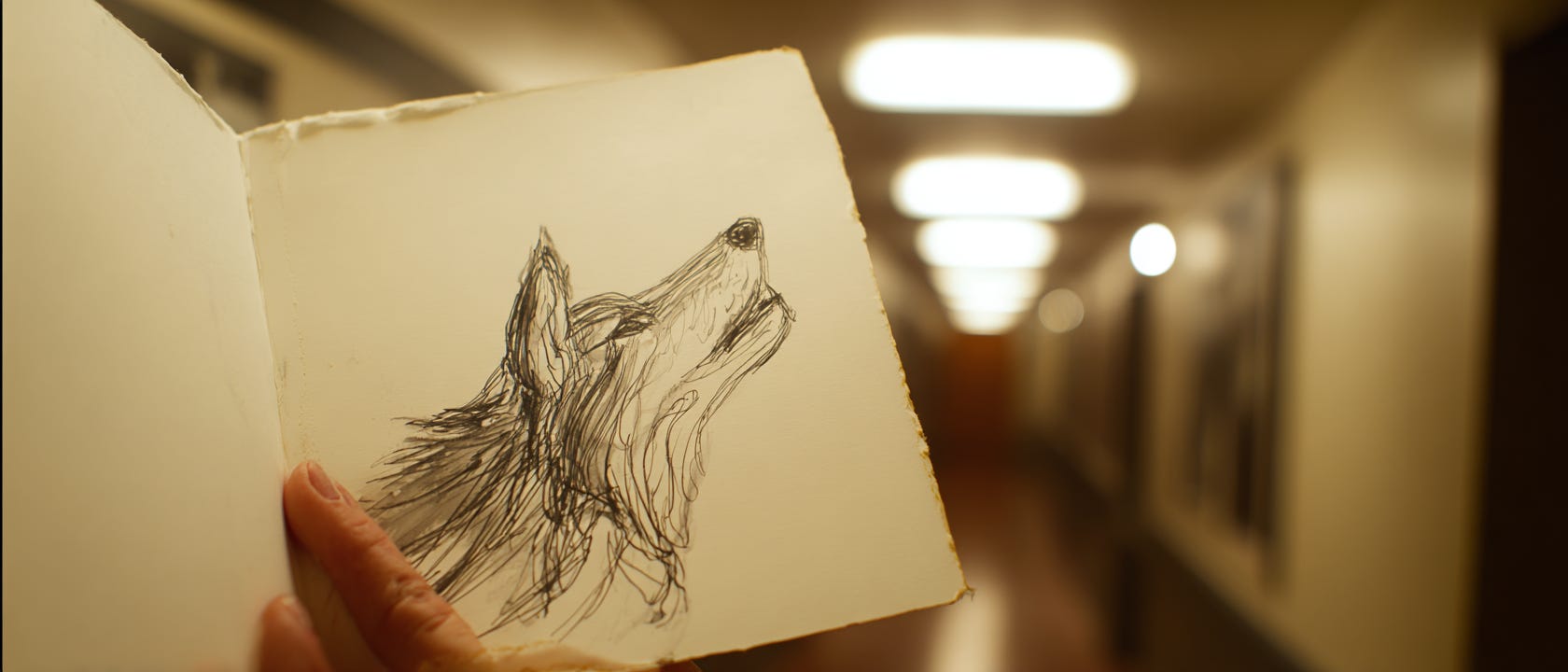
The Wolf

Teddy Snyder never imagined that a single afternoon could bend a whole semester’s reputation. He was the “good kid” in Mr. Hargrove’s sophomore class, quiet, diligent, the sort of student who earned extra credit for turning in assignments early and never raised his hand in protest. When the school announced a “peer‑support” day for the LGBTQ+ alliance, Teddy’s name appeared on the list beside a name he’d never heard spoken aloud: Casey Liu.
Casey’s profile on the school’s online directory listed a pronoun preference of “they/them,” a short bio that mentioned a love for graphic novels and a talent for sketching. The next day, a rumor rippled through the hallway: Casey had been the target of a taunting group for dressing in an ambiguous gender style, tight black jeans, a loose‑fitting sweater, a silver chain around a wrist that was neither quite a bracelet nor a watch. The bully’s leader, a senior named Trent, shouted, “Who’s the next runway model? Look at the ‘fashion disaster’!” The crowd laughed, and a few younger students followed suit, whispering and pointing.
The faculty meeting that followed was a blur of sighs and polite gestures. Mr. Hargrove, eyes flickering between his coffee and the stack of disciplinary forms, assigned Teddy the job of escorting Casey from the cafeteria to the auditorium for a planned discussion panel. The instruction was simple: stay beside them, keep the path clear, and most importantly, don’t make a scene.
Teddy took the task as a courtesy, not a calling. He imagined walking beside Casey like a shadow, unobtrusive and invisible, the sort of presence that would go unnoticed by the crowd and, therefore, keep everyone safe. He rehearsed the phrase in his head: “I’m just here to make sure we get to the room, nothing more.” In his mind, invisibility equaled protection.
When lunchtime ended, the cafeteria emptied, the echo of clattering trays fading into a low hum. Teddy found Casey leaning against a locker, sketchbook balanced on their knees, a thin line of ink forming a jagged silhouette of a wolf. Casey’s eyes flicked up, wary.
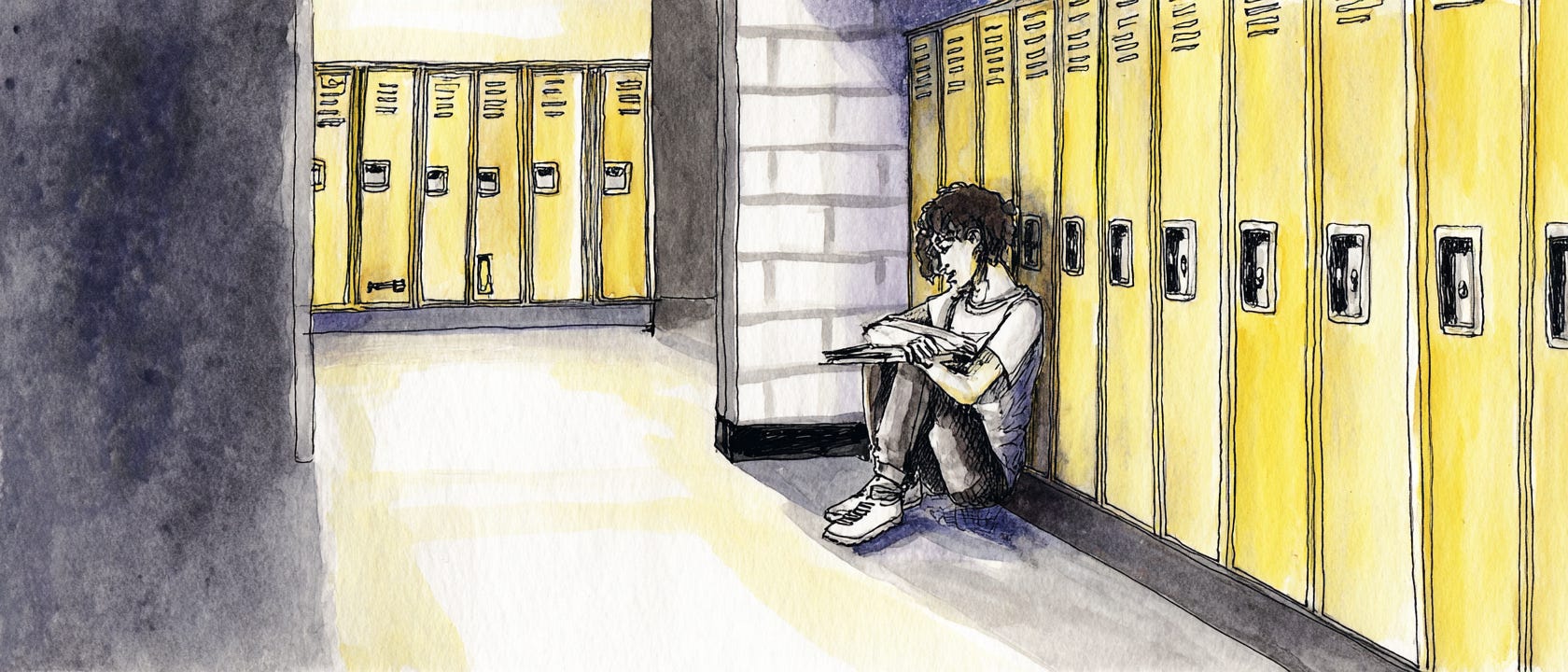
“You ready?” Teddy asked, his voice barely rising above the ambient chatter.
Casey nodded, their lips forming a small, tentative smile. “Yeah. Thanks for… for doing this.” Their hand brushed his, a brief contact that sent a tremor through Teddy’s stern composure.
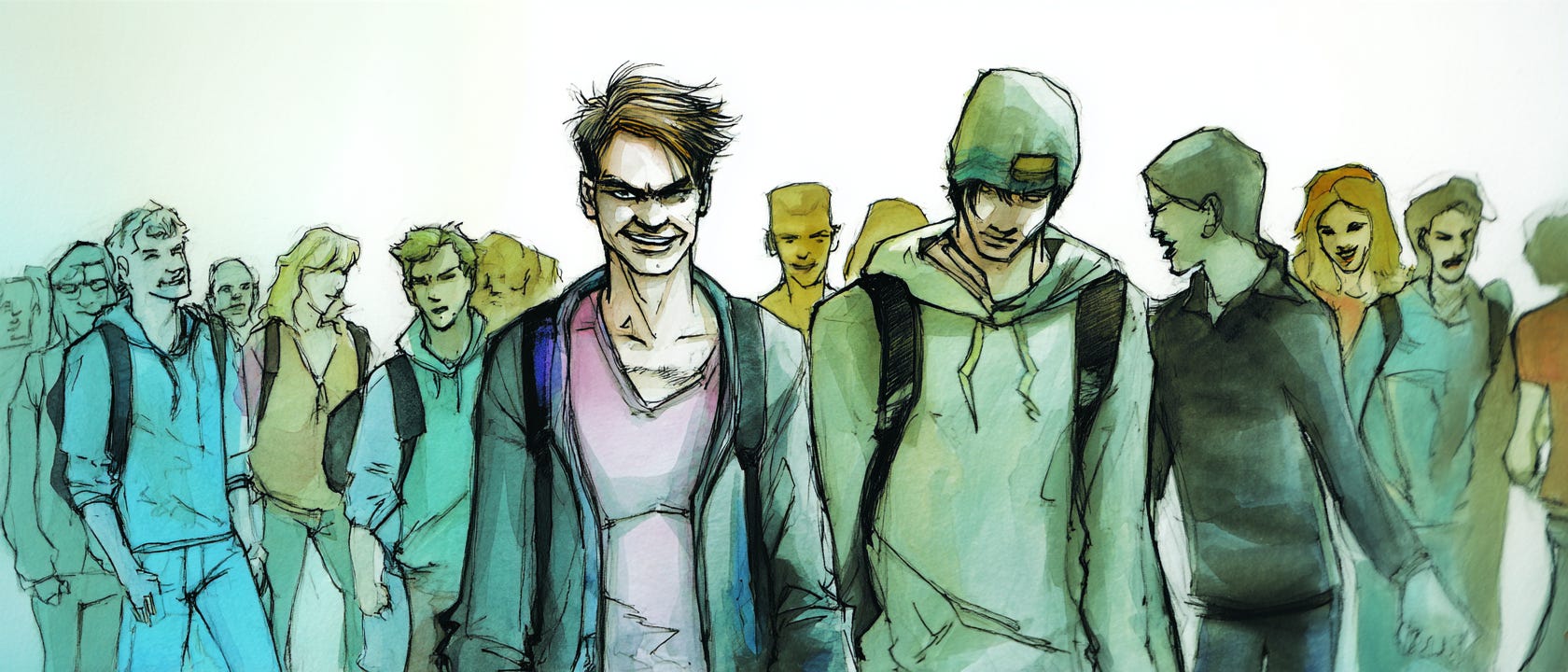
The hallway was a gauntlet of murmurs. As they walked, a group of students formed a loose circle, their heads swiveling toward Teddy and Casey. Trent, his black hair slicked back, stepped forward, eyes glittering with mischief.
“Hey, Snyder! Who’s the new accessory?” He gestured at Casey’s chain, laughing. “Looks like the school’s getting a new mascot, ‘The Walking Gender ‘?”
The hallway erupted. Some snickered; a few others pretended not to hear. Teddy’s stomach clenched. He could see Casey’s shoulders slump, the pencil in their hand shaking.
“Just ignore them,” Teddy whispered, his tone tight. “We’re almost there.”
Casey’s eyes darted to the floor, then back up. “Why do they have to be so loud?”
Teddy felt the weight of the words settle like ash on his skin. He had promised to be invisible, no words, no gestures, no interference. Yet his mind replayed the scene: a student in a sweater, a chain that caught the flicker of fluorescent lights, a crowd of laughing peers. Teddy’s own silence seemed to thicken the air, making the taunts louder, as if his quiet compliance was a signal that the harassment could continue.
In that moment, an older student, Ms. Morales, the counselor who had been tasked with overseeing the peer‑support day, stepped into the hallway. Her eyes, sharp and compassionate, locked onto Trent. “Trent,” she said, voice steady, “you seem to have forgotten the school’s code of conduct. Harassment, especially based on gender expression, is not tolerated.”
The crowd’s laughter faltered. For a heartbeat, the hallway throbbed with tension. Teddy felt his own heart pounding, not from fear, but from an emerging realization that invisibility was not neutral. By staying mute, he had been part of the backdrop that allowed the cruelty to play out.
“Hey,” Teddy said, louder than he had intended, “maybe you could—”
Trent turned, his eyes flashing. “What? You gonna tell me how to behave? Keep your eyes on the walk, Snyder. We’re not waiting for your… moral lesson.”
Casey’s grip tightened on the sketchbook, the wolf’s jagged teeth now sharply inked, a silent scream on paper.
Teddy swallowed. The world seemed to narrow to the space between his shoulders and his resolve. He thought of the wolf in the sketch, its eyes fierce despite its broken form. The wolf did not retreat; it snarled.
“You think this is a joke,” Teddy said, his voice steadier now, “but it’s not. It’s a day to stand up for someone who’s just trying to be themselves. If we stay quiet, we’re saying it’s okay. If we speak up, we’re saying it isn’t.”
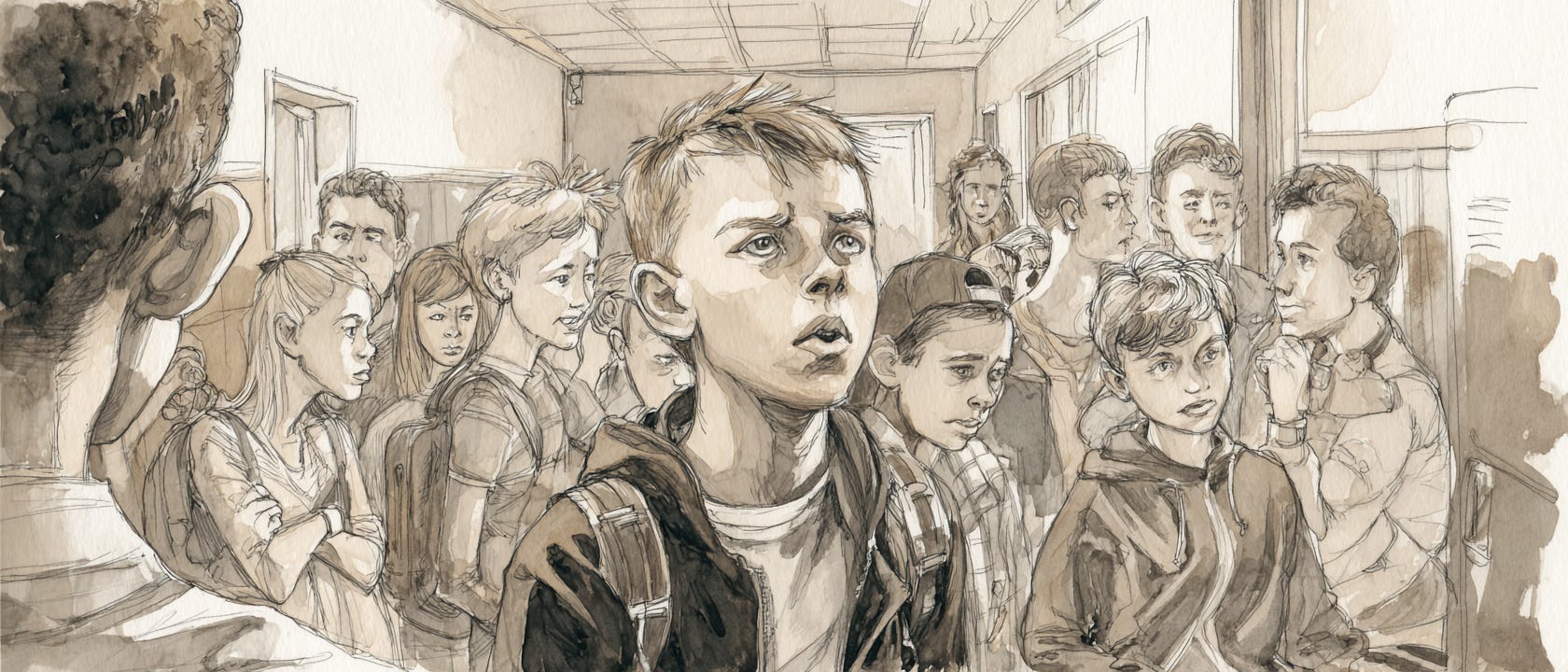
A murmur rippled through the hallway. Some students looked away, uncomfortable; others shifted, uncertain. Trent’s face hardened, but before he could retort, Ms. Morales placed a firm hand on his shoulder.
“Please, Mr. Trent, follow me to the office,” she said. The surrounding teachers, who had been observing from the periphery, stepped forward. The hallway’s atmosphere shifted.
Teddy turned to Casey. “Are you okay?” he asked.
Casey’s eyes filled with a quiet gratitude. “I thought you’d just… walk with me. I didn’t expect you to speak up.”
Teddy felt a warmth blossom in his chest, a feeling Teddy that was both unfamiliar and right. “I think I’ve been trying to stay invisible for too long,” he admitted, looking at the wolf now fully inked in the sketchbook. “Maybe it’s time to be seen, at least when it matters.”
They continued on to the auditorium, the crowd parting for them, the teachers nodding in approval. The panel discussion began, and Casey’s voice, trembling at first, grew steadier as they spoke about the importance of visibility, of being seen not as a target but as a person. Teddy sat beside them, not as a silent guardian, but as an ally who had chosen to intervene.
When the meeting ended, several students approached Casey, offering apologies and words of support. Trent, escorted to the office, slunk away, his shoulders lowered. Teddy felt a shift in his own posture, no longer trying to shrink, but to stand.
Later, in the empty hallway, Casey slipped a fresh page into their sketchbook and handed it to Teddy. It was the same wolf, now poised with a raised head, eyes blazing.
“Thanks,” Casey said softly. “For seeing me.”
Teddy looked at the drawing, then at the person standing beside him. “Thank you for letting me see,” he replied, a smile breaking across his face. In the quiet that followed, the school’s fluorescent lights seemed less harsh, the lockers less imposing. For the first time in months, Teddy understood that being a “good kid” didn’t mean staying unseen; it meant using his presence to protect, to speak, and to change the space around him.
As they walked out together, the hallway, once a battlefield of whispers, now felt like a corridor of possibilities. The wolf in the sketch, once a symbol of fear had become a banner of courage, and Teddy, no longer invisible, Teddy carried it forward.