

What People Carry

By late June, the heat in the San Fernando Valley had settled in for good.
It pressed against storefront windows and shimmered over Ventura Boulevard. It rose from parking lots in visible waves and made every metal door handle feel faintly accusatory. Inside the glass-front dental office where Marisol Ruiz had worked for twenty-seven years, the sterilizer hummed behind the counter, steady as a second clock.
Marisol wore her name badge like armor.
M. Ruiz
Receptionist
She had perfected the art of being visible only in the most functional way. A warm smile. A calm voice. A practiced How can I help you today? Then the patient left, and she slipped back into the background.
Efficient. Pleasant. Forgettable.
There were advantages to being forgettable. People did not ask what you thought. They did not expect you to take sides. They did not notice when you swallowed a sentence before it became dangerous.
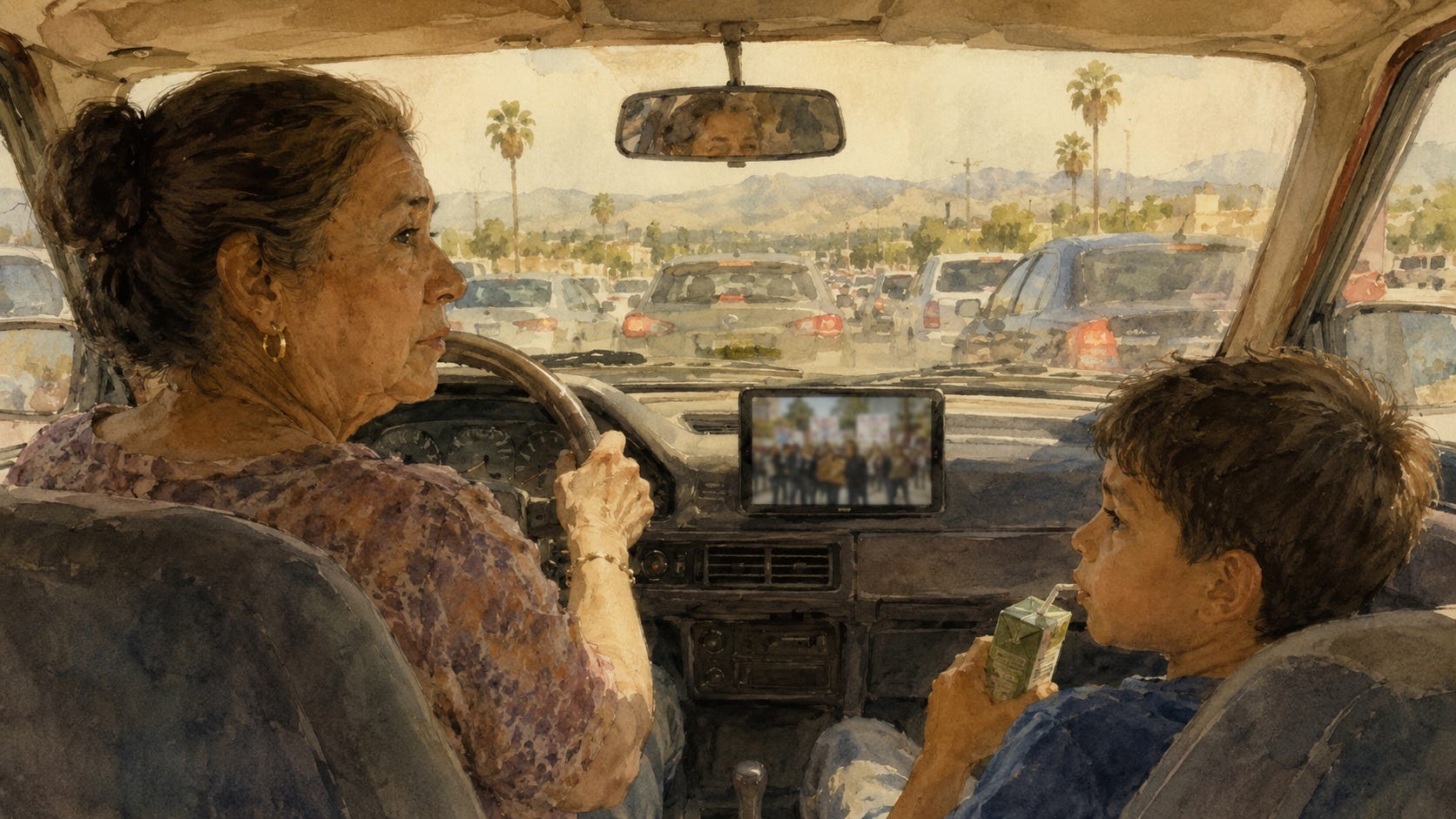
That afternoon, after her shift, she picked up her grandson Leo and drove west in her 2012 Honda Fit, the air conditioner pushing out a tired stream of lukewarm air. Leo, eight years old and all elbows and restless energy, bounced in the passenger seat with a juice box wedged between his knees.
He smelled like sunscreen, library books, and the gummy vitamins Carla insisted were not candy even though Leo treated them like contraband.
At a red light, Marisol glanced at the small screen clipped to the dash. A local news station was running footage from protests across the country. Crowds filled streets and parks, holding signs over their heads. People shouted into microphones. A banner flashed across the screen:
NO KINGS
“Grandma,” Leo said, squinting at the screen, “why do grown-ups have signs that say that?”
Marisol kept her eyes on the road. “Because they think someone in charge is acting like they don’t have to answer to anybody.”
Leo thought about that. “But why are they yelling?”
She gave a small shrug. “Sometimes people yell when they think nobody’s listening.”
He turned toward the window, quiet for a moment.
“Can’t they just talk?”
The question stayed with her longer than she expected. It sat there under her ribs, small and hard.
At the next light, her phone lit up in the cup holder with an old text thread from her daughter Carla, still open from the night before. They had argued again. Carla had gone to one of the local protests with friends. Marisol had told her to be careful, to stay out of trouble, to come home before dark.
Carla’s answer had come back fast and cold.
You always think staying quiet is the same as being good.
It was the kind of sentence Carla had been throwing at her since she was sixteen, only now it had grown teeth.
Marisol had not replied.
She told herself she was letting things cool down. That was what she always told herself. Let it cool down. Let people settle. Let the hard thing pass until it no longer demanded anything from her.
Now she looked again at the screen. The coverage had shifted to a rally in a park not far from where they were. Hand-lettered signs. Police barricades. A reporter speaking into a microphone while people moved behind her in waves.
Leo was still looking out the window.
“Do you want to go see?” Marisol heard herself say.
He turned. “See what?”
“What people are upset about.”
His face brightened with reckless curiosity. “Really?”
Marisol surprised herself by nodding. “Really.”
She told herself they would drive by, nothing more. Just a look. Just enough to answer a child’s question.
But ten minutes later she was pulling into an overflowing lot beside the park, and the air outside hit her like the opening of an oven door.
The crowd was larger than she expected.
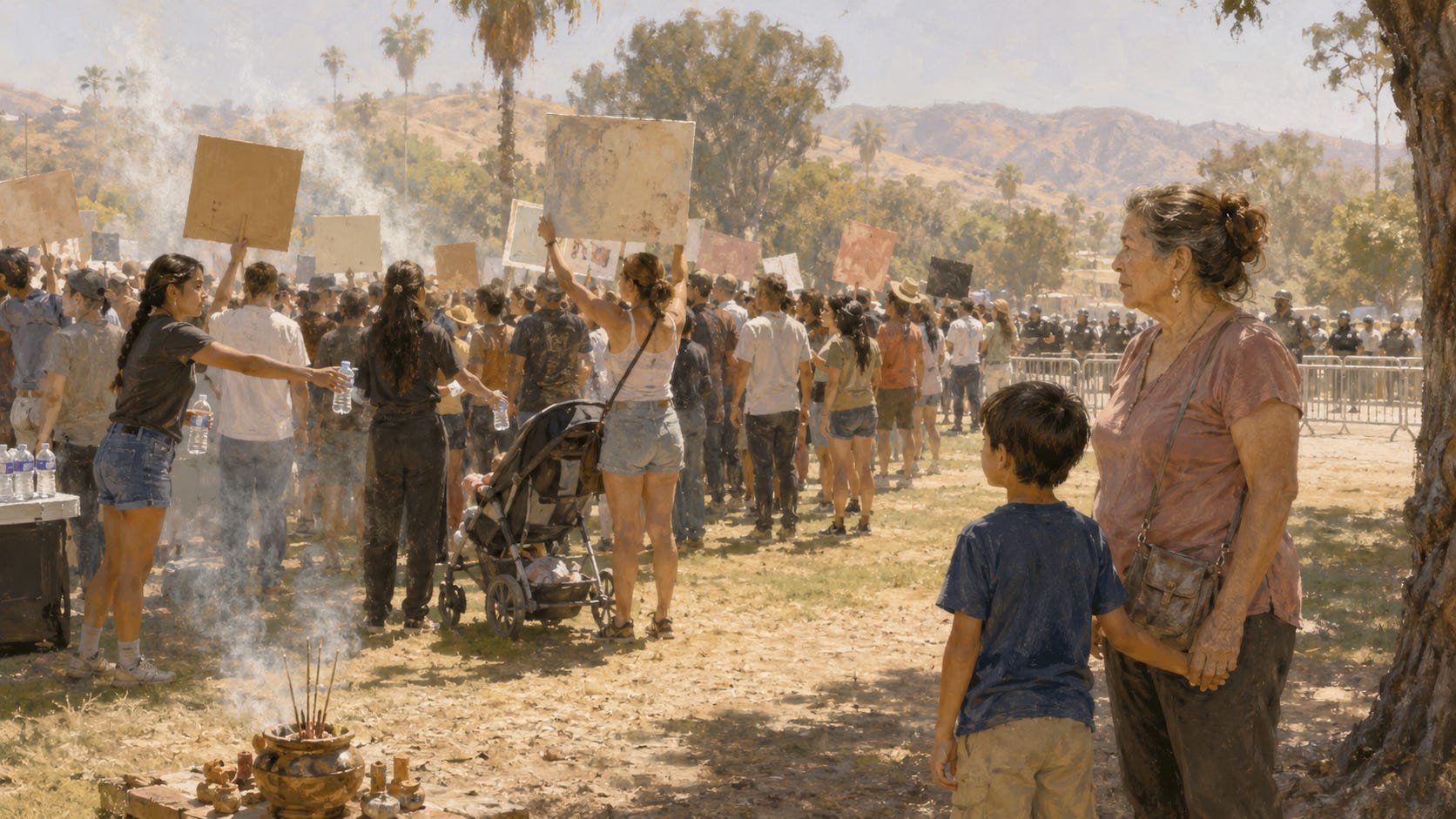
Not wild, not exactly, but charged. Homemade signs bobbed above people’s heads. Some were funny, some angry, some so carefully painted they looked prepared days in advance. A teenager handed out water bottles from a cardboard box. A woman pushed a stroller with one hand and held a sign with the other. Someone nearby had brought a drum. Somewhere else incense drifted through the heat.
One cardboard sign caught Marisol’s eye because the letters were uneven, as if painted by a child.
MY FATHER IS NOT A THREAT
She looked away before Leo could ask about it.
Marisol took his hand.
“Stay with me,” she said.
They moved toward the edge of the crowd, close enough to hear but far enough, she hoped, to leave easily if things turned. A man on a portable sound system was talking about immigration raids, about families separated, about fear being turned into policy. The crowd answered in bursts. Some clapped. Some shouted. A few people simply stood there, still and grim, as if they had come because staying home had finally become heavier than showing up.
Then, from the other side of the walkway, another cluster of voices rose to meet them.
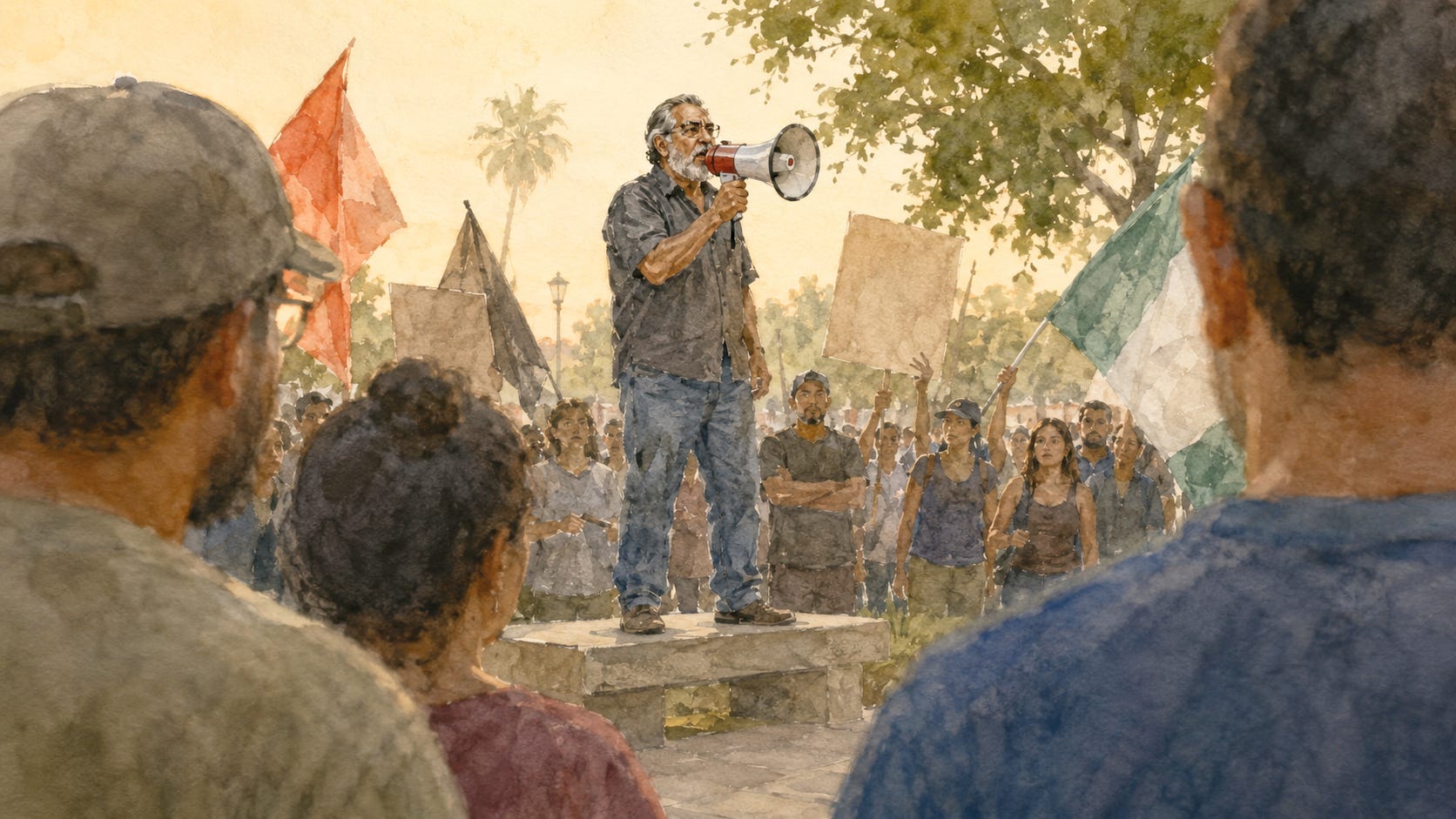
A smaller group had gathered across from the main protest, holding flags and their own signs. One man stood on a low concrete bench, speaking into a bullhorn with the confidence of someone used to being watched.
Marisol knew him before she fully saw his face.
Diego.
Her ex-husband.
His beard was trimmed close now, streaked with gray. He looked older, harder around the mouth. But his voice was the same one that used to fill every room they ever shared. That voice had once made waiters nervous, neighbors look away, and Marisol shrink herself down to the size of a yes.
He was talking about law and order, about border security, about a country losing its nerve. Not the exact opposite of the larger crowd, Marisol realized, but close enough to catch fire. He had always needed an audience more than an answer.
Leo looked up at her. “You know him?”
Marisol’s fingers tightened around his hand. “Yes.”
Diego turned slightly between one sentence and the next and saw her.
For a second he stopped.
Then he stepped down from the bench and crossed toward them, handing the bullhorn to someone else.
“Marisol?”
She almost laughed at the disbelief in his face. “Leo wanted to know why people were shouting,” she said. “I thought maybe we’d take a look.”
Diego glanced at the boy, then back at her. “This isn’t a great place for that.”
As if on cue, a burst of yelling broke out near the barricades. Nothing catastrophic, but enough to shift the air. Two men got in each other’s faces. A bottle hit the pavement and shattered. Police moved quickly toward the knot of bodies.
Leo flinched.
Marisol felt it through his hand.
“Okay,” she said. “We’re leaving.”
But leaving turned out to be harder than arriving. Officers were already redirecting people away from one side of the park. Cars were boxed in. One exit had been blocked by a police vehicle, another by a standstill line of traffic inching toward the boulevard.
Diego looked toward the lot. “You’re not getting out fast from here.”
“I can manage.”
He gave her the look she remembered too well, the one that used to arrive just before he decided what was best for everybody.
Then he stopped himself.
Something in his face altered. Not much. Just enough.
“Please,” he said. “Get in the car. I’ll help you circle around the back streets.”
Against her better judgment, and because Leo’s face had gone pale, Marisol followed him.
Leo climbed into the back seat of Diego’s battered sedan. Marisol slid into the passenger seat, already regretting everything.
The car smelled faintly of coffee, dust, and old vinyl. Diego started the engine and eased forward into a line of cars barely moving.
For a long stretch nobody said anything.
Outside, the protest kept breathing around them. Chants rose and fell. Police radios crackled. Sirens flared and softened in the distance. A helicopter hovered somewhere beyond sight, its blades chopping the heat into pieces.
Leo leaned forward between the seats. “Are we stuck?”
“For a little while,” Marisol said.
“How long is a little while?”
Neither adult answered.
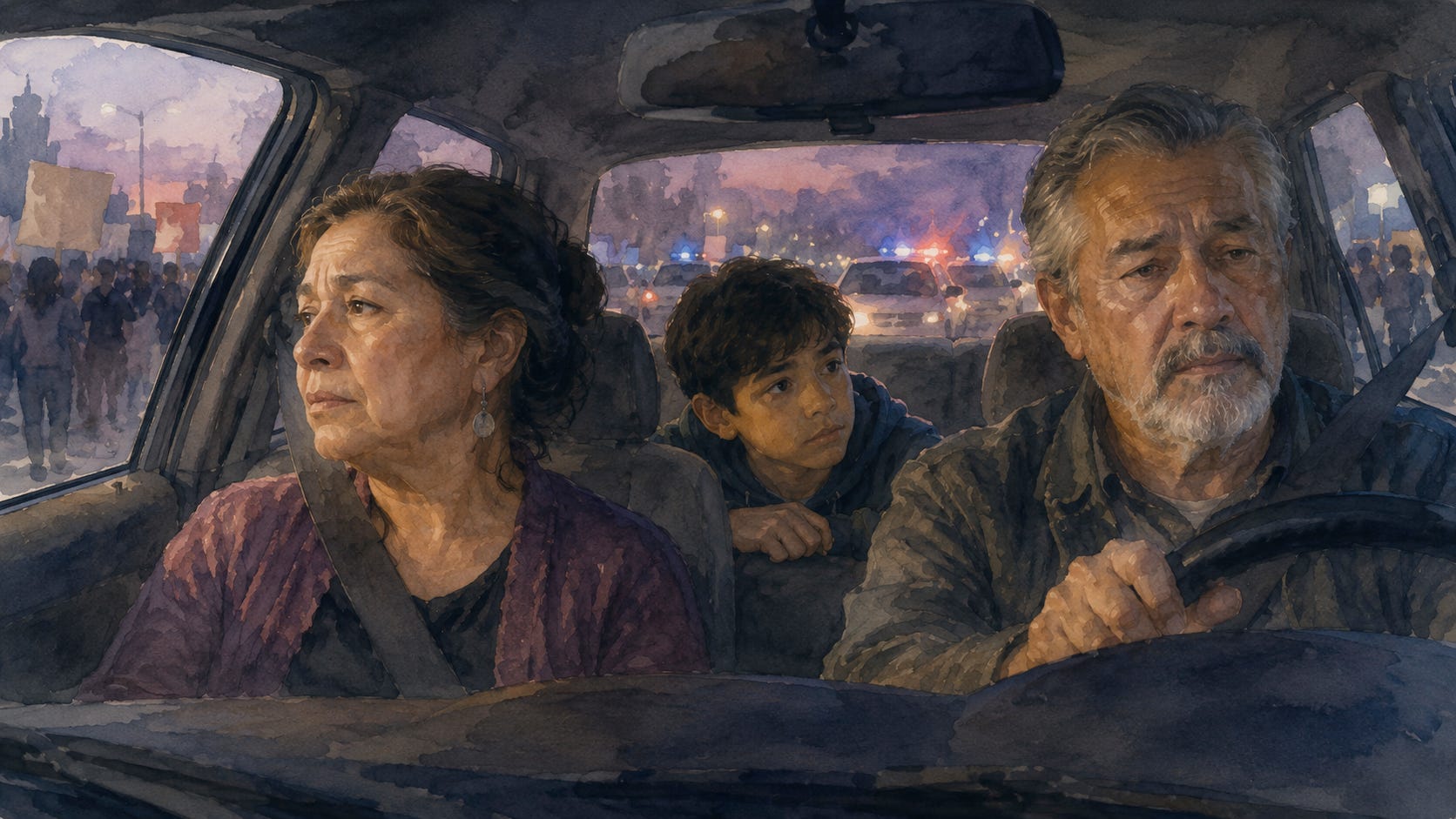
The traffic crawled. Sometimes it stopped for ten minutes at a time. Diego drummed his fingers once against the steering wheel, then forced himself to stop.
Finally Marisol said, “You’re part of this now?”
He gave a short laugh without humor. “Everybody’s part of it now.”
“That’s not an answer.”
He kept his eyes ahead. “I got tired of people acting like fear makes you stupid. Some things are worth protecting.”
“And shouting is the only way to do that?”
He turned to her briefly. “You tell me. How’s staying quiet worked out for you?”
The words landed cleanly, with no place to dodge.
In the back seat, Leo had gone still again, listening.
Marisol looked out the window. A young woman sat on the curb crying, her protest sign folded across her lap. Nearby, an officer crouched to speak to her, not touching her, just waiting until she looked up. A man walked past carrying three unopened water bottles hooked through his fingers. Somebody farther off began chanting again, but with less force now, as if the day had worn itself hoarse.
“I wasn’t trying to disappear,” Marisol said at last.
Diego’s mouth twitched. “No? You were good at it.”
She almost snapped back, but didn’t. Because he wasn’t entirely wrong.
“I thought keeping the peace mattered,” she said.
“It does.”
“No,” she said quietly. “Keeping everyone comfortable mattered. That’s different.”
That shut him up.
The car moved six feet, then stopped again.
From the back seat, Leo’s voice came small but clear.
“Why do people get so scared?”
Marisol turned halfway toward him. His eyes were wide, not panicked, just trying to understand the size of what he had seen.
Before she could answer, Diego spoke, softer than she had heard him in years.
“Because once people are scared enough, they start thinking being louder means being right.”
Leo considered that.
“That seems dumb,” he said.
Marisol let out a laugh before she could stop it. Diego did too.
And just like that, something in the car loosened.
Not fixed. Not healed. Just loosened.
More time passed. The sun lowered. Shadows stretched across the dashboard. Diego told Leo which streets he used to drive when Carla was little. Leo asked if his mother had talked as much as he did.
Marisol said, “More.”
Diego said, “Impossible.”
Leo grinned for the first time since the bottle hit the pavement.
The phone in Marisol’s purse buzzed once. Then again.
She knew without looking that it was Carla.
She let it ring.
Then, after another minute, she took it out anyway. The screen glowed in her hand.
Don’t come home pretending this was just sightseeing.
Marisol stared at the words.
Beside her, Diego kept his eyes on the road. “She still mad at me?”
“Yes.”
He nodded. “Fair enough.”
Traffic inched forward. An officer waved three cars through the next break in the barricade.
Diego said, almost to himself, “I used to think if I made enough noise, I’d never have to feel helpless.”
Marisol looked at him.
He kept going. “Turns out you can be loud your whole life and still not say the thing that matters.”
She thought about that.
Her thumb hovered over Carla’s name. For once, she did not rehearse the safest version of herself.
She pressed call and lifted the phone to her ear.
Her daughter answered on the second ring.
“Mom?”
Marisol closed her eyes for one beat.
“Hi, honey.”
Carla’s voice came fast, brittle with worry. “Where are you? Leo okay? I saw what was happening near the park and then you weren’t answering and I swear to God, Mom, if you took him there just to prove some point…”
“Leo’s okay,” Marisol said. “I’m okay too.”
A pause.
Then, more quietly, Carla said, “Why did you go?”
Marisol looked out through the windshield at the last of the backed-up cars, the officers, the tired people carrying signs at their sides now instead of over their heads, the whole frayed human scene of it.
She thought of the dental office. The name badge. The years of making herself useful instead of known.
She thought of Carla at sixteen, furious in the kitchen, saying, You never say anything until it doesn’t matter anymore.
She thought of Leo asking why people yelled.
“I think,” she said slowly, “I got tired of confusing silence with safety.”
Nothing came back for a second.
Then Carla breathed in. “That doesn’t sound like you.”
“No,” Marisol said. “Maybe it should have.”
When they finally reached the dental office parking lot, twilight had settled over the valley.
Leo climbed out first, spotlit for a moment by the overhead security lamp. Carla’s car pulled up near the curb, and he ran toward it, then turned and waved back at both of them.
At both of them.
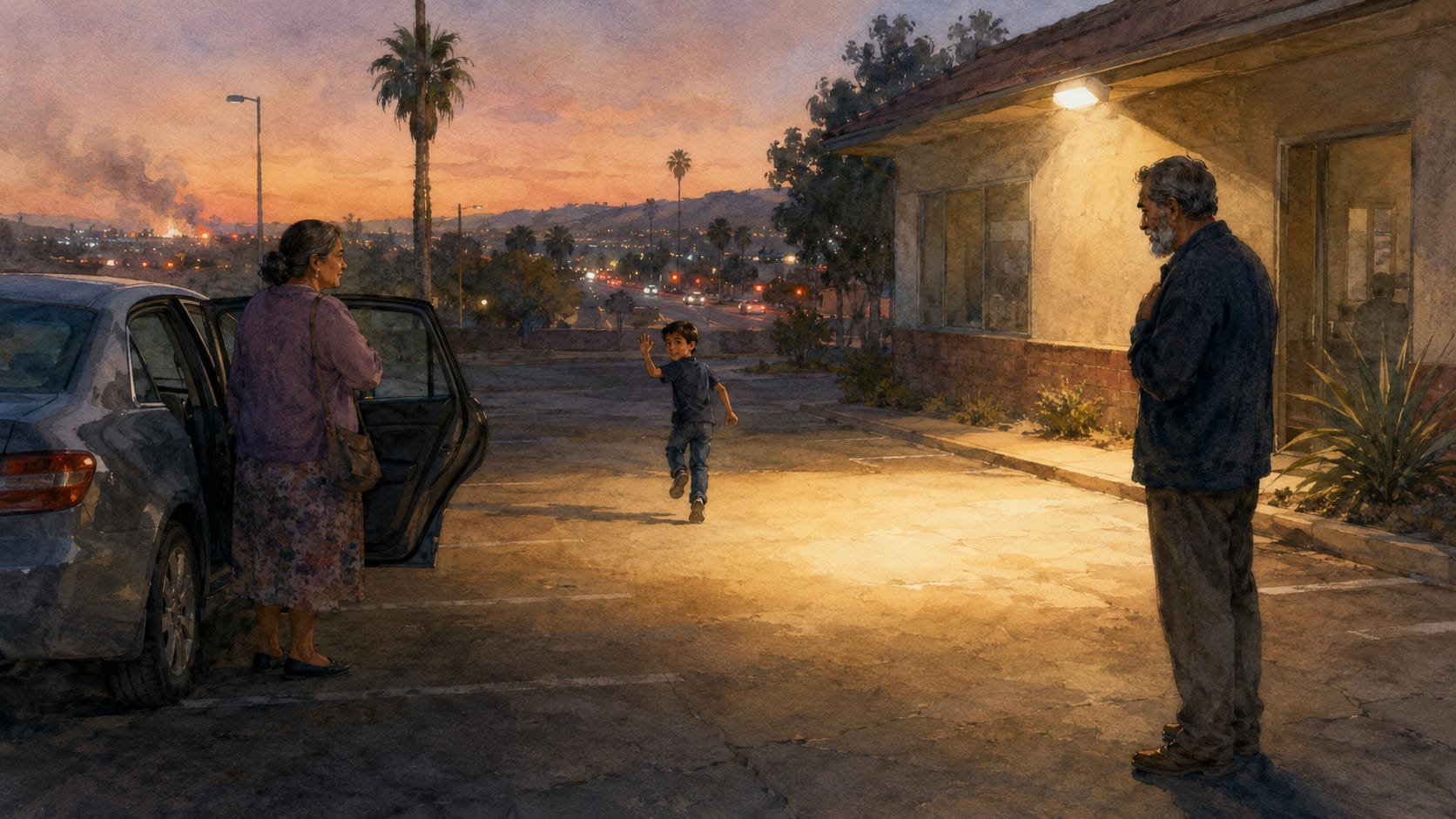
Marisol stood beside the open passenger door. Diego came around the front of the car and stopped a few feet away.
For a moment neither spoke.
Then Diego said, “I’m sorry.”
There was no speech attached to it. No excuse. No flourish. Just the words.
Marisol looked at him, really looked at him. Not the version she had fought with. Not the one she had blamed for everything. Just the aging man in front of her, tired and stubborn and late, but sincere.
“I know,” she said.
It was not absolution. It was not a reunion.
But it was true.
He nodded once and stepped back.
Carla was waiting now, one arm resting on the roof of her car, Leo beside her, watching. Marisol slipped her phone into her purse and started walking toward them.
Behind her, the last distant chant from the park drifted into the evening and disappeared into traffic.
This time, she did not keep walking past what mattered.